
Women’s Menstrual Health & Period Cramp Relief Solutions in India
Menstrual health is a critical yet often overlooked aspect of women’s overall well-being in India. Millions of women experience monthly discomfort, particularly period cramps (dysmenorrhea), which significantly affects their daily activities, productivity, and quality of life. Despite its prevalence, menstrual health remains surrounded by stigma, limited awareness, and inadequate access to safe and effective solutions.
Prevalence of Period Pain (Dysmenorrhea) in India

- Around 70.2% of women/students in India suffer from menstrual cramps
- Other studies show range: 46% – 76% prevalence
- Some localized studies show even higher rates up to 84%
Severity of Period Pain (India Data)
Official Study:
- 34.2% Severe pain
- 36.6% Moderate pain
- 29.2% Mild pain (PMC)
Lunora+ Research & Development Study
Heat-Assisted Diclofenac Transdermal Patch for Menstrual Pain Management
Lunora+ is an advanced heat-assisted transdermal therapeutic system designed to address primary dysmenorrhea (menstrual pain) through a dual-action approach:
- Controlled therapeutic heat (~40–42°C)
- Localized delivery of diclofenac (NSAID)
Diclofenac is a clinically established analgesic for menstrual pain, with strong evidence ranking it among the most effective OTC options. However, conventional oral administration is associated with gastrointestinal side effects, while standard topical systems suffer from limited skin permeation.
Lunora+ introduces a scientifically engineered solution that leverages controlled heat to enhance drug diffusion across the skin. Based on diffusion principles and clinical thermotherapy evidence, heat can increase transdermal drug flux by ~2×, significantly improving local drug delivery.
This project integrates drug delivery science, thermal engineering, and women-centric design, aiming to create a non-invasive, wearable, and scalable therapeutic platform.
Clinical Need & Problem Statement
Primary dysmenorrhea affects a significant proportion of women globally and is characterized by:
- Elevated prostaglandin levels
- Uterine hypercontractility
- Reduced uterine blood flow
Limitations of Current Therapies
- Oral NSAIDs (e.g., diclofenac): Effective but associated with gastrointestinal risks
- Heat therapy: Clinically beneficial but lacks portability and sustained delivery
Unmet Need
A solution that is:
- Portable and discreet
- Continuous and long-lasting
- Combining comfort with therapeutic efficacy
Scientific Rationale
Role of Diclofenac
Diclofenac acts by inhibiting cyclooxygenase (COX) enzymes, thereby reducing prostaglandin synthesis—the key driver of menstrual cramps. Clinical analyses rank diclofenac among the top-performing NSAIDs for dysmenorrhea management.
Transdermal Delivery Advantage
- Localized drug action
- Reduced systemic exposure
- Avoidance of gastrointestinal side effects
However, standard transdermal systems show limited permeability, with flux typically in the range of 1–5 µg/cm²·h, necessitating enhancement strategies.
Role of Heat Therapy
Controlled heat (~40°C):
- Promotes vasodilation
- Relaxes uterine muscles
- Modulates pain signals
Clinical evidence suggests that continuous low-level heat can provide pain relief comparable to NSAIDs in certain cases.
Heat-Assisted Drug Delivery
Based on Fick’s Law of Diffusion, drug flux increases with temperature due to:
- Higher diffusion coefficient
- Increased skin permeability
- Enhanced local blood circulation
Studies indicate that increasing skin temperature from 32°C to ~42°C can double drug flux, forming the core scientific foundation of Lunora+.
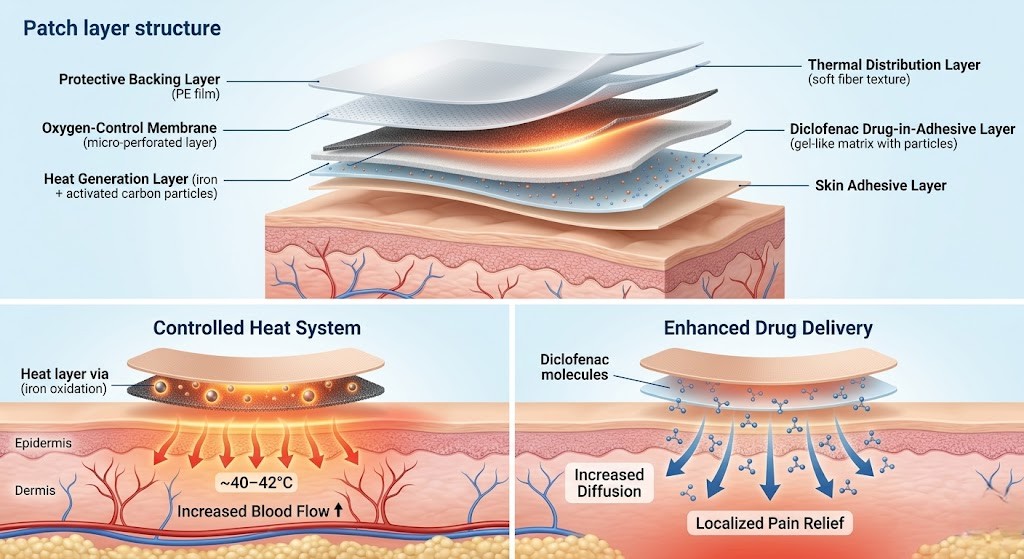
Formulation & Material Engineering
Multi-Layer Patch Architecture
The patch consists of:
- Breathable outer backing layer
- Oxygen-control membrane
- Heat-generating core (iron-based system)
- Thermal distribution layer
- Drug-in-adhesive matrix
- Skin-contact adhesive layer
- Release liner
Technology Overview: Dual-Action Patch
Lunora+ integrates two synergistic systems:
Controlled Heat System
- Temperature: 40–42°C
- Duration: 6–8 hours
- Mechanism: Iron oxidation reaction with oxygen-controlled membrane
Drug Delivery System
- Diclofenac embedded in a drug-in-adhesive polymer matrix
- Enhanced with penetration enhancers (e.g., oleic acid, propylene glycol)
- Designed for sustained and localized release
This structure ensures:
- Controlled heat delivery
- Uniform temperature distribution
- Stable and sustained drug release
Penetration Enhancement Strategy
To overcome low baseline permeability, Lunora+ incorporates chemical enhancers, including:
- Oleic acid (OA): Lipid disruption for increased permeability
- Isopropyl myristate (IPM): Enhances lipid fluidity
- Propylene glycol (PG): Improves drug solubility and hydration
- Menthol: Dual role as enhancer and mild analgesic
These enhancers work synergistically with heat to significantly improve transdermal flux and drug bioavailability.
Safety Considerations
Thermal Safety
- Target temperature: ~40°C
- Upper safety limit: ≤42°C
- Oxygen-controlled design prevents overheating
Drug Safety
- Expected systemic exposure significantly lower than oral diclofenac
- Reduced gastrointestinal risk
Skin Compatibility
- Use of hypoallergenic medical-grade adhesives
- Planned irritation and sensitization testing